On this page
Marienplatz and the Rathaus
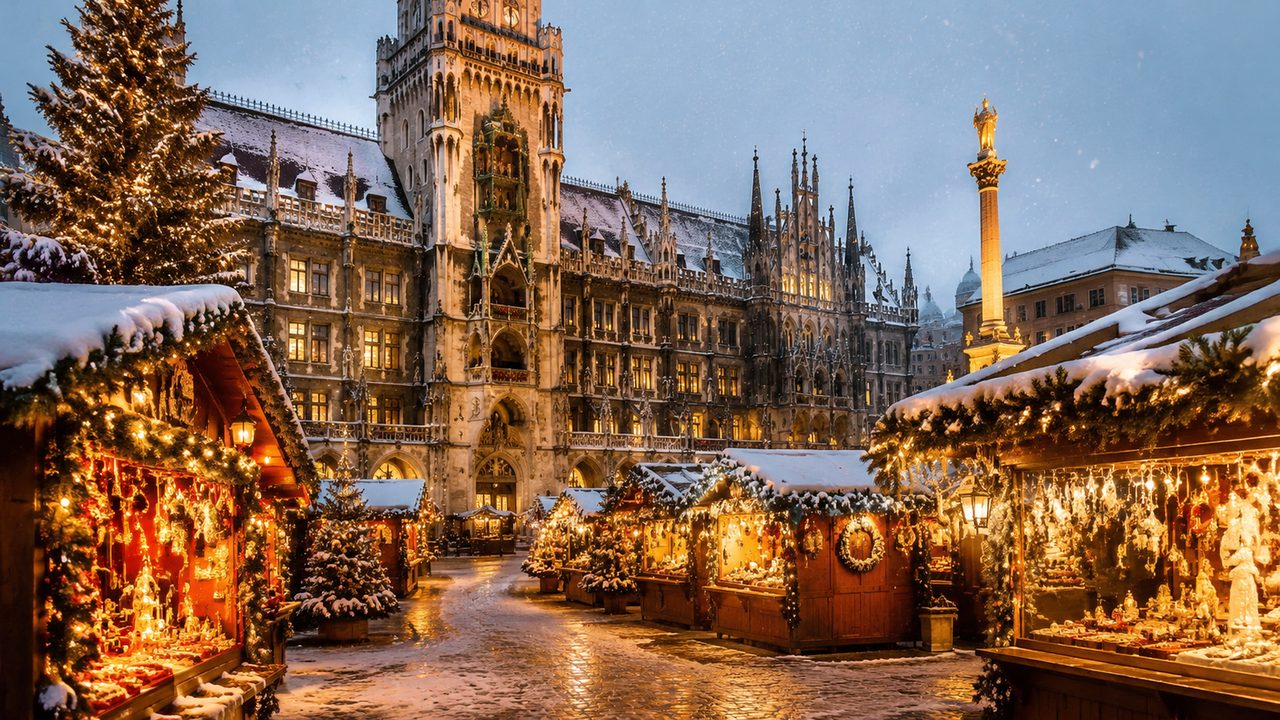
Munich's Christkindlmarkt occupies the city's most famous square, with the New Town Hall's gothic facade as its backdrop and the Glockenspiel performing from the tower balcony at 11am, noon and 5pm. The market has run on Marienplatz in its modern form since the 1970s, and the layout is now a fixture: around 130 stalls arranged around the central tree, with the square's statue of Mary at one edge and the Viktualienmarkt food hall a short walk away. It is the busiest market in the city and, on a good evening, one of the most beautiful in Germany.
What to eat
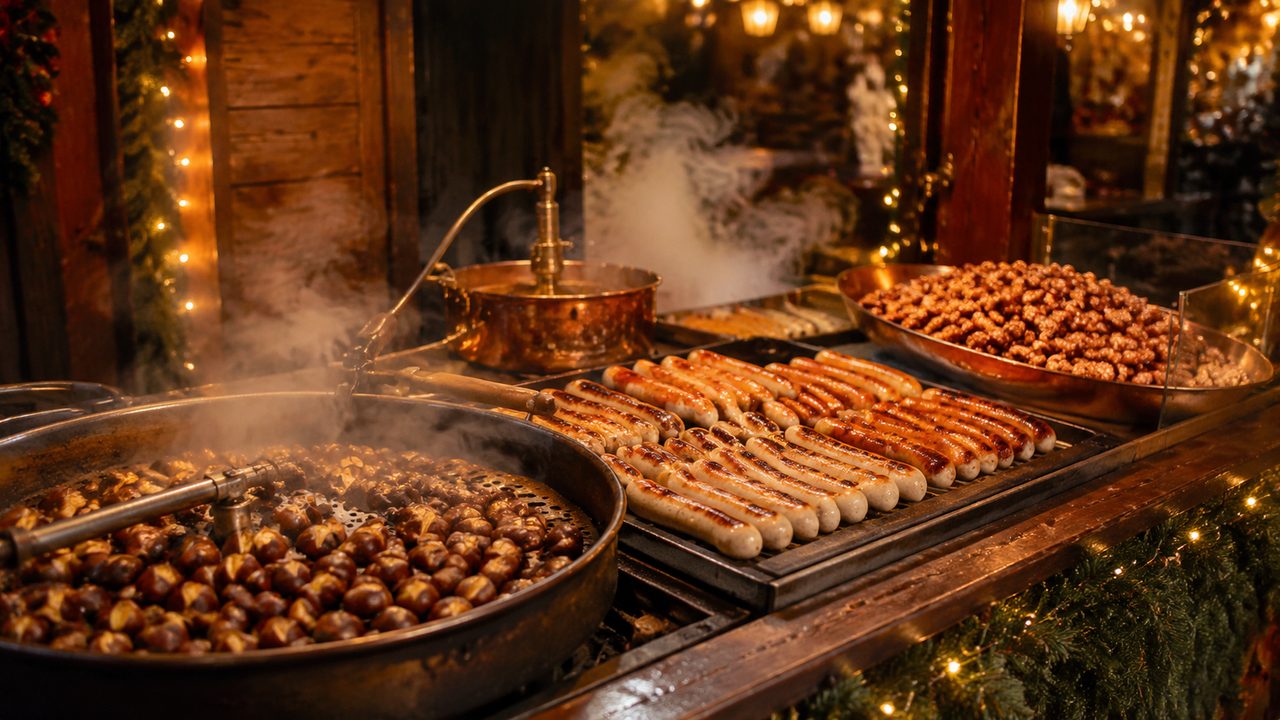
The Munich specialties are easy to find. The pink heart-shaped gingerbread — Lebkuchenherzen with icing messages — hangs in rows at the souvenir stalls and is the market's signature purchase. The savoury standard is the bratwurst, served here in the Bavarian way with sweet mustard and a roll. Glühwein runs about €4.50 to €5 with the mug deposit, and the local twist is Feuerzangenbowle, the flaming rum-and-sugar version served from a copper bowl. For a quieter table, the Viktualienmarkt's food stalls, just off the square, serve the same winter food with less queue.
Beyond the main square
Munich's December is bigger than Marienplatz. The Tollwood Winterfestival at Theresienwiese, on the site of the Oktoberfest, is the alternative market: big tents, live music, global food and a deliberately non-traditional crowd, running through the same weeks. Schwabing's Christkindlmarkt, in the leafy northern district, is smaller and calmer with an artisan focus. The medieval market at Wittelsbacher Platz sells handcrafted goods by candlelight, and the small market in the courtyard of the Residenz, the old royal palace, sells candles and cribs to a largely local crowd in the most elegant setting in the city. The full Munich experience is a circuit: Marienplatz for the classic, Tollwood for the edge, Schwabing for the calm.
The craft side
Munich's market leans harder into craftsmanship than the big tourist markets further north. Alongside the usual ornaments you will find Bavarian woodcarving, Christmas cribs, candles, glassware and the region's traditional nativity figures. The stalls nearer the Frauenkirche end of the square carry the most serious craft, while the ones closest to the Rathaus sell the souvenirs. If you want something that will still be on your tree in a decade, buy from the craftsmen and pay the difference — the quality gap is real.
Dates and rhythm
The 2024 Christkindlmarkt ran 25 November to 24 December, opening around 10am and closing about 9pm, with Christmas Eve wrapping up by early afternoon. The market's calendar drives the city's: the first Sunday of Advent brings the opening festivities, and the two Saturdays before Christmas are the crush. The weekdays of the first two weeks of December are the quiet window, and the evenings after 8pm, when the school groups have gone, are the most atmospheric. Munich's airport and rail connections make it an easy base for a wider Bavarian trip.
Practical notes
Marienplatz is served directly by the U-Bahn, which drops you at the market's edge — useful in December weather. Most stalls take cash, and the small-notes rule applies as everywhere. Market toilets are paid and busy, so use the department stores on the square. The Glockenspiel performance is worth timing, but note that the tower balcony draws its own crowd; arrive ten minutes early. And if you are visiting Tollwood as well, give it a separate evening — the two markets are a twenty-minute walk apart and deserve their own time.