On this page
Two markets, two moods
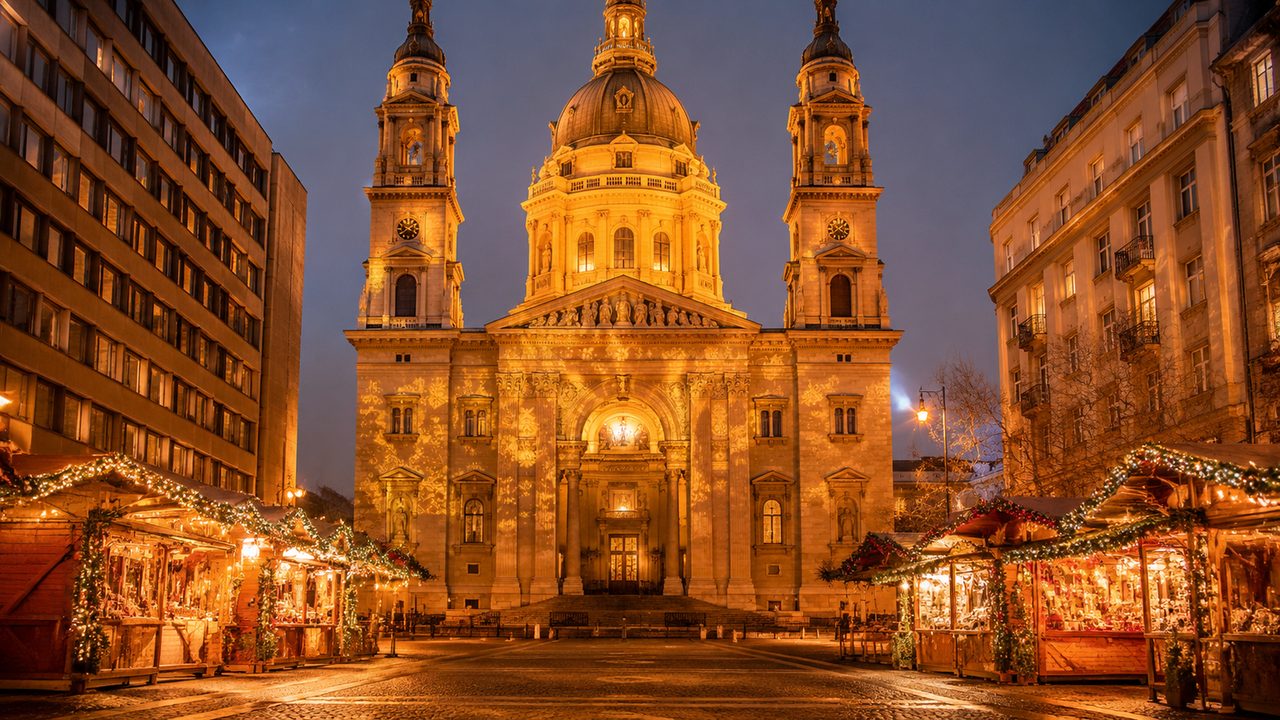
Budapest's Christmas splits into two acts about fifteen minutes apart on foot. The first is the grand old market at Vörösmarty Square, which has run since the 1990s and is the one postcards show. The second is the Advent Bazilika at Szent István Square, a younger, artier fair set at the foot of St Stephen's Basilica, whose facade becomes a screen for a projection show every evening. They complement each other: the first for tradition, the second for spectacle, and both for food.
Vörösmarty Square
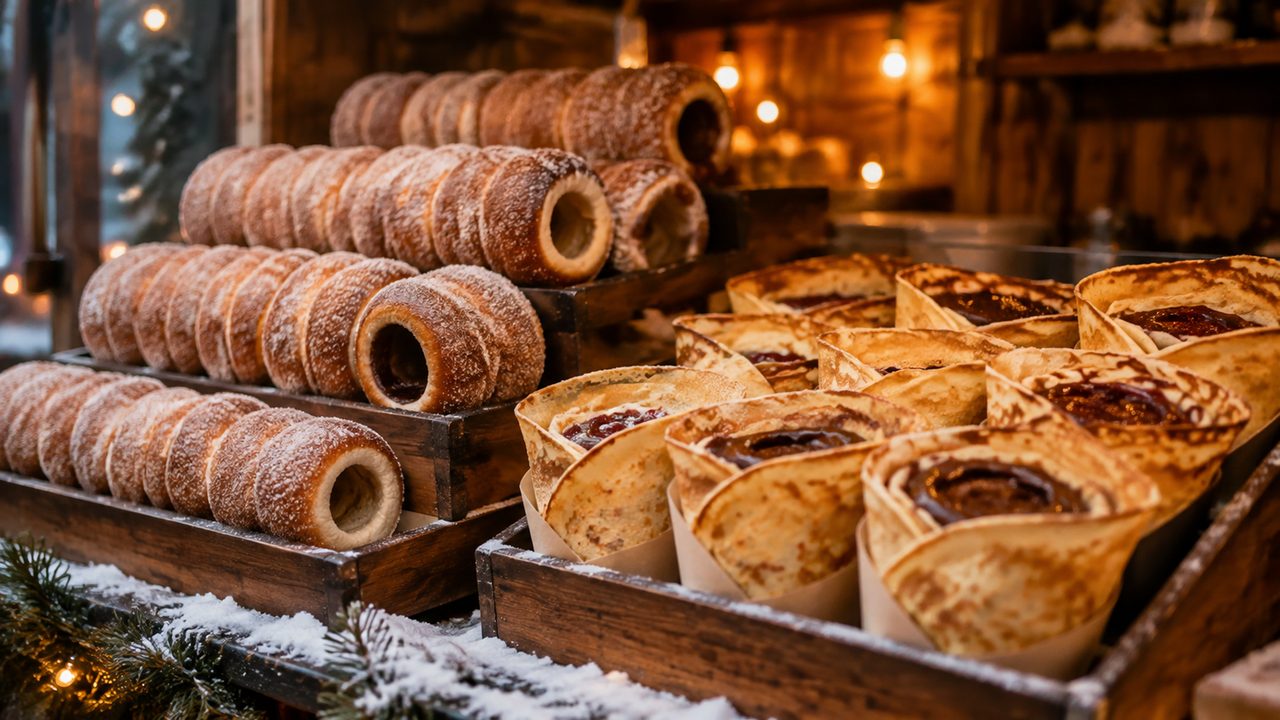
Vörösmarty is Budapest's main Christmas market, ringed by the Gerbeaud café and the city's smartest shopping street. Its wooden chalets sell handmade ornaments, embroidered textiles and ceramics, and the food stands do serious trade in kürtőskalács, the chimney cake grilled on a spit and rolled in sugar, cinnamon or crushed walnuts. The square runs from late November to New Year's Day, and its evening crowd is thick but good-natured. Weekday mornings are the quiet window; the last days of December are the busiest.
The Advent Bazilika
The Advent Bazilika at Szent István Square is the newer show. After dark, a 3D projection mapping turns the basilica's facade into a slowly shifting canvas of snow, stained glass and festive patterns, and the crowd gathers in front with cups of forralt bor — Hungarian mulled wine, usually red, spiced with cinnamon and cloves. The market itself is smaller than Vörösmarty's and skews toward artisan goods: glass blowers, candle makers, ceramicists. An ice rink sits at the side of the square on some years, and the whole scene has a cathedral view that Vörösmarty cannot match.
The food to look for
Chimney cake is the market snack: about 1,200 to 1,500 forint, pulled hot off the spit and handed over in a paper sleeve. Lángos — fried dough topped with sour cream, cheese and garlic — is the savoury counterpart, filling enough to count as a meal. Forralt bor runs around 1,000 to 1,500 forint a cup, often served in a boot-shaped mug that doubles as a souvenir; return the cup for a deposit or keep it, whichever the stall offers. The sweet version is mézes forralt bor, mulled white wine with honey, worth trying once.
Beyond the two squares
If you have more than an evening, Budapest's winter spreads further. The Great Market Hall on the Pest side of the Liberty Bridge keeps its vaulted iron roof busy year-round and is worth a morning for paprika, strudel and sausage. The Christmas fair at Buda Castle runs in the Castle District, quieter than the Pest markets and with a view back across the Danube. In December the city also strings lights along Andrássy Avenue, the grand boulevard leading from the city centre to Heroes' Square, and the tram ride up the avenue is a free light show worth an evening on its own. And the city's thermal baths — Széchenyi in particular — are the classic cold-weather reward after a day of standing on cobblestones.
Practical notes
Both markets run roughly from late November to 1 January, with stalls typically opening around 11am and closing around 9pm. Take forint cash for the smaller stands; most food stalls accept cards but the single-vendor chalets often prefer cash. Crowds peak on weekends and on New Year's Eve, and the projection show on the basilica draws its biggest audience after 8pm — go for the 6pm showing instead, when the square is emptier. Budapest is well connected to Vienna and Prague by rail, which makes it a natural part of a Central European circuit.