On this page
The dessert stall geography
Map the sweet stalls of Europe's markets and a pattern emerges: each country sends its own ambassador, and the market adopts it. The French send the crêpe, the Czechs the trdelník, the Hungarians the lángos, the Belgians the waffle and the Spanish the churro. The stalls travel well — you will find trdelník in German markets and crêpes everywhere — but the version is always best near home, where the locals are the customers.
Crêpes
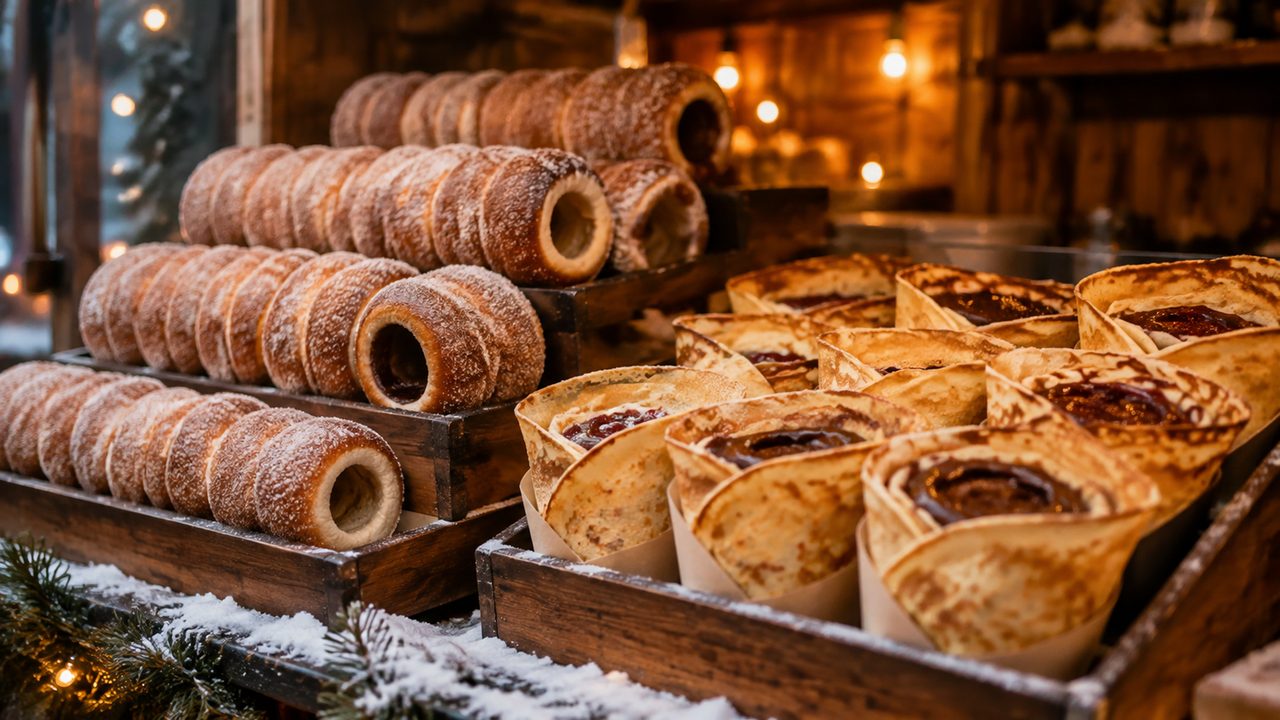
The crêpe is the workhorse of the dessert circuit: a thin pancake cooked on a round griddle, folded over a filling and handed over in a paper sleeve. The classic market orders are sugar and lemon, or chocolate spread folded into the middle, at €3.50 to €5 depending on the filling. The quality marker is the batter, not the filling: a good stall makes them fresh to order and the queue moves fast enough that the griddle never goes cold. In France and Belgium the crêpe stand is a permanent winter fixture; elsewhere it appears at every market worth the name.
Trdelník
Trdelník, the Czech chimney cake, is the market dessert that conquered central Europe. Strips of sweet dough are wrapped around a wooden or metal spit, grilled over coals until golden, then rolled in sugar, cinnamon, walnuts or coconut and pulled off the spit like a hollow cone. In Prague it has become the city's signature street food, sold for about €2.50 to €4, often with a filling of ice cream or cream added on top — a modern twist the traditional bakers quietly disapprove of. The original, plain and hot, is the one to try first.
Lángos, the savoury-sweet hybrid
Hungary's lángos is technically savoury — deep-fried dough topped with sour cream, grated cheese and garlic — but it occupies the dessert stall's corner of the market and its regulars order it like one. The base is a flat disc of fried dough, crisp at the edges and soft in the middle, and the toppings are applied while it is still hot enough to melt the cheese. In Budapest it costs around 1,000 to 1,500 forint, and the garlic version is the benchmark. Lángos proves the market rule that the best "dessert" is often the one you can justify as dinner.
Churros and waffles
Spain brings the churro — ridged fried dough, rolled in sugar and served with a cup of thick hot chocolate for dipping — and Brussels and Belgium bring the waffle, cooked fresh on a hot iron and topped with powdered sugar, whipped cream or chocolate. Both are orders with a ritual attached: churros are eaten standing at the stall, waffles are carried carefully, and neither survives a long walk in a paper bag. At a Belgian market the waffle is the non-negotiable order; at a Spanish winter fair, the churro with chocolate is the whole point.
The rest of the sweet shelf
Beyond the big four, the market sweet shelf fills with locals: roasted almonds and hazelnuts coated in sugar, candied apples, marzipan figures, chocolate-dipped fruit, and the regional oddity — Vienna's marzipan potatoes, Dresden's stollen slices, Alsace's bredele biscuits. These are the souvenirs of the dessert world: small, wrapped and portable. The roasted almond stall, in particular, is the one queue worth joining at every market, because the smell alone justifies the wait.
How to choose
Three rules. First, eat local: trdelník in Prague, churros in Spain, waffles in Belgium, crêpes in France. Second, watch the queue — a long line at a dessert stall means fresh batter and a hot griddle, which matters more than the toppings. Third, pace yourself: the market dessert is a sharing order, not a full meal, and the sugar hits harder in the cold. Order one sweet thing per square, and you will have room for the sausage at the next one.