On this page
The market's main dish
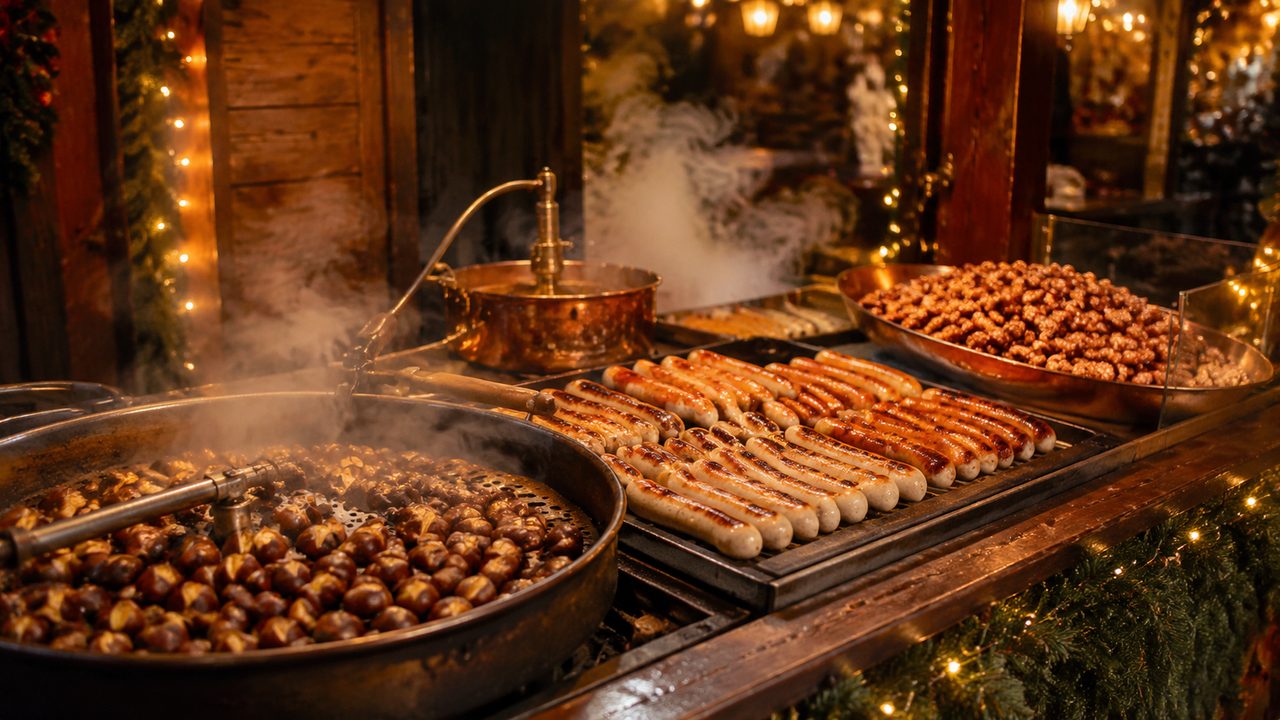
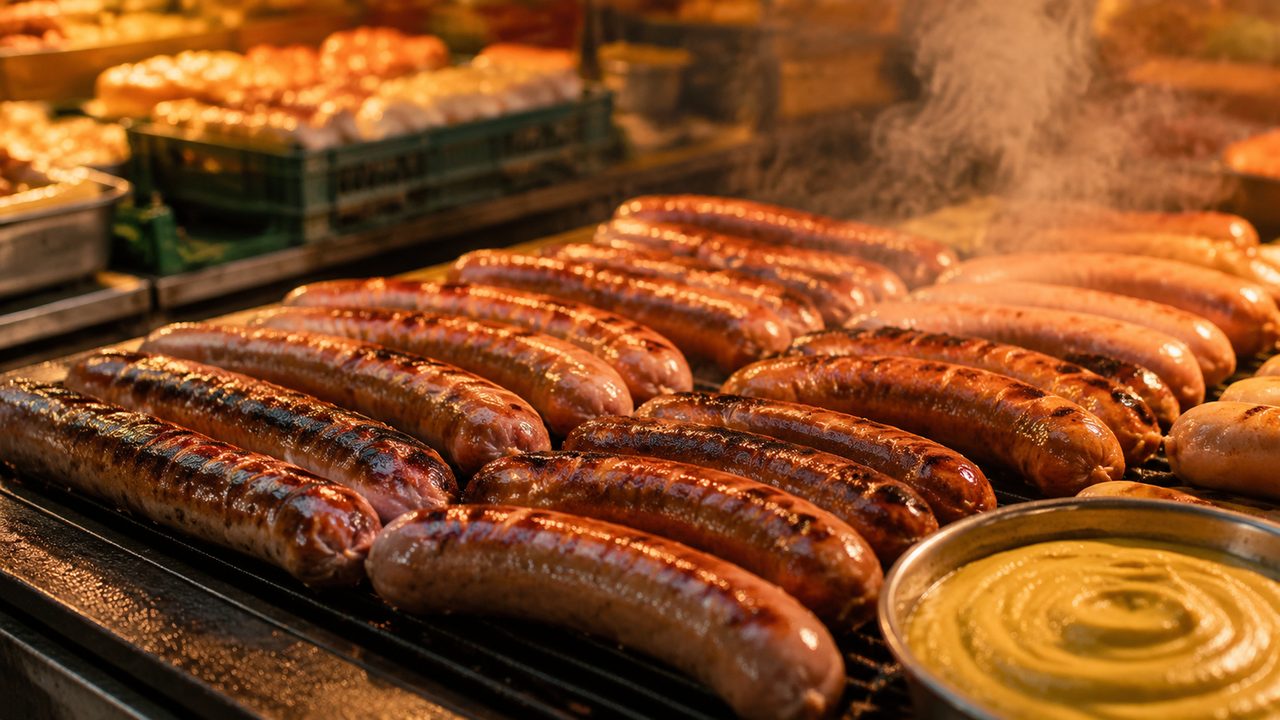
Walk into any German-speaking market at lunch and the queues tell you everything: the sausage stands do more business than anything except the mulled wine. The reasons are practical. A sausage needs no cutlery, cooks in minutes, survives being eaten standing in a crowd, and fills a cold stomach for a couple of euros. Every market country has its own version, and the differences are a mini-lesson in local food culture — same concept, completely different recipes.
Germany: bratwurst country
Germany's market standard is the bratwurst: a finely ground pork sausage grilled over coals and served in a crusty roll, usually with mustard. The regional variations are fierce. Nuremberg's bratwurst is famously small — city rules cap it at about nine centimetres — and the classic order is drei im Weggla, three in a roll, for around €4.50. The Thüringer version is longer, coarser and served with a sharp mustard that the stallholders will apply if you let them. Either way, order by pointing at the grill and holding up fingers; the system is faster than any words.
Berlin's currywurst
Berlin's answer is the currywurst: a boiled-then-grilled sausage sliced into coins, drowned in a spiced tomato sauce and dusted with curry powder. The story credits a Berlin stallholder named Herta Heuwer, who is said to have improvised the sauce in 1949 from ketchup, Worcestershire sauce and curry powder; the city now has a currywurst museum and fierce arguments about whose version is best. At a market, order it with the roll on the side, and specify "mit Darm" if you want the version with a natural casing — Berliners have opinions on this too.
Austria: käsekrainer and friends
Austrian markets offer the bratwurst too, but the local speciality is the käsekrainer, a smoked pork sausage stuffed with small cubes of cheese that melt when grilled — order it with a slice of bread and a dollop of sweet mustard, and you will see why it out-sells everything else at Vienna's stands. Also look for the frankfurter, served in Austria with bread and horseradish rather than in a bun, and the burenwurst, a coarser cousin of the bratwurst. The Austrian market stand is a good place to learn the deposit-mug rhythm: collect, eat, return the cup, keep walking.
The rest of Europe
Outside the German-speaking core, the sausage changes nationality. Prague's markets serve klobása, a smoked Czech sausage grilled and sold in a thick slice; Budapest's have kolbász, often spiced with paprika and eaten with bread and onion; Copenhagen's winter stands sell the classic red Danish pølser with remoulade and crispy onions. In Poland, kiełbasa appears at markets in grilled segments with mustard and bread. The ordering principle is universal: point at what is on the grill, accept the standard garnish, and pay with small notes.
How to order and pay
A few rules make every sausage stand go smoothly. Have the money ready before you reach the front — most stalls take cash, and a €50 note at a €5 stand will slow everyone down. Learn the two phrases that matter: mit Senf (with mustard) in German-speaking countries, and "the roll on the side" if you prefer to eat it plain. Do not stand at the counter after you have your food; the space in front of the grill is for ordering, and the crowd behind you is real. And treat the first bite with respect — market sausages are served straight off the fire and are considerably hotter than they look.